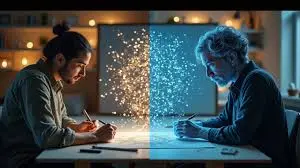
Neural networks are transforming creativity from a purely human-driven process into a collaborative space where machines assist, enhance, and accelerate creative work. Instead of replacing creativity, modern AI systems extend it, helping designers, marketers, and artists generate ideas, visuals, and concepts at unprecedented speed through creative AI insights. At the core of this shift are neural networks capable of learning patterns, styles, and structures that resemble human creative thinking.

Understanding Creativity in Artificial Intelligence
Creativity in the context of artificial intelligence does not mean emotion or imagination in the human sense. Instead, it refers to the ability of AI systems to generate novel, relevant, and context-aware outputs based on learned patterns. Neural networks analyse vast datasets of images, text, and designs to understand structure, style, and relationships.
Rather than “inventing” ideas, AI recombines existing knowledge in new ways. This computational creativity allows AI to produce original-looking designs, artworks, and concepts that meet practical creative goals, such as branding consistency or visual storytelling.
How Neural Networks Generate Visual and Design Content
From Training Data to Creative Output: The Core Process
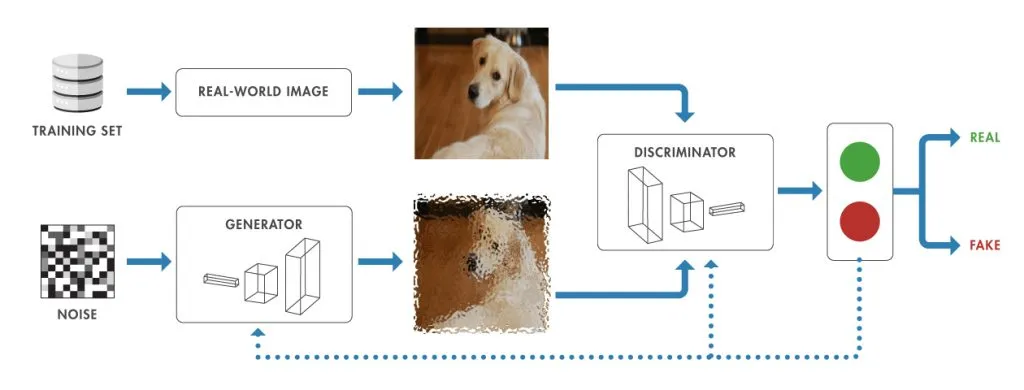
Neural networks are trained on large datasets containing images, layouts, colours, typography, and visual styles. During training, the model learns statistical relationships between elements, such as how shapes, lighting, or composition typically interact.
When generating content, the network does not copy existing work. Instead, it predicts what a “new” image or design should look like based on learned patterns. This process allows AI to create visuals that feel original while still aligning with established design principles.
Key Types of Neural Networks Used in Creative AI
Generative Adversarial Networks (GANs) in Visual Creation
GANs use two competing neural networks—one generating images and the other evaluating them. This competition pushes the system to produce increasingly realistic and refined visuals. GANs are widely used in digital art, photo enhancement, and style generation.
Diffusion Models and Their Role in Image Generation
Diffusion models work by gradually transforming random noise into detailed images through multiple refinement steps. This approach produces high-quality, coherent visuals and is especially effective for complex scenes and artistic detail.
Transformer-Based Models for Text-to-Image Creativity
Transformer models excel at understanding context and relationships in text. When combined with visual data, they enable text-to-image systems that convert written prompts into detailed visuals with strong semantic accuracy.
Popular AI Tools That Use Neural Networks for Creative Work

AI Image Generation Platforms for Designers and Creators
Modern image-generation platforms use advanced neural networks to turn prompts into artwork, illustrations, and concept visuals. Tools like Midjourney have become popular among designers for rapid ideation and visual experimentation.
Neural Network Tools for Branding, Templates, and Layouts
Some creative AI tools focus on structured design tasks such as branding, templates, and layouts. Platforms like Wepik apply neural networks to automate visual consistency, spacing, and composition for non-designers and professionals alike.
Text-to-Image Systems Powered by Advanced Neural Models
Text-to-image systems convert written descriptions into visuals using large neural models trained on paired text and image data. Solutions developed by organisations like OpenAI demonstrate how neural networks can bridge language and visual creativity.
Real-World Use Cases of Neural Network Creativity
Graphic Design and Digital Art
Designers use AI-generated visuals for concept exploration, mood boards, and rapid prototyping. Neural networks reduce time spent on repetitive tasks, allowing creatives to focus on refinement and storytelling.
Marketing, Advertising, and Social Media Content
AI-generated creatives help marketers produce visuals at scale for ads, campaigns, and social media. Neural networks adapt styles quickly, enabling faster A/B testing and content localisation.
Product Design and Concept Visualisation
In product design, neural networks generate early-stage concepts and variations. This accelerates ideation and supports better decision-making before physical prototyping begins.
Limitations and Ethical Considerations of AI-Generated Creativity
Despite its power, AI creativity has limitations. Neural networks depend heavily on training data, which can introduce bias or restrict originality. Ethical concerns also arise around copyright, originality, and attribution, especially when AI outputs resemble existing works.
Responsible use requires transparency, human oversight, and clear boundaries between inspiration and imitation. AI should support creativity, not undermine creative ownership.
How Neural Networks Are Changing the Creative Industry
Neural networks are reshaping creative workflows rather than eliminating creative roles. Designers and artists increasingly act as directors—guiding AI systems, refining outputs, and applying human judgment. This shift increases productivity while preserving creative control.
Agencies and teams that adopt AI strategically gain speed, scalability, and competitive advantage without sacrificing quality.
Future Trends in Creative AI and Neural Networks
Future creative AI systems will become more interactive, context-aware, and customisable. Neural networks will better understand brand identity, emotional tone, and audience intent. Collaboration between human creativity and AI intelligence will become more seamless, shaping a hybrid creative future.
Frequently Asked Questions About Neural Networks and Creativity
Can neural networks truly be creative?
Neural networks do not think creatively like humans, but they can generate novel outputs by learning and recombining patterns in data.
Are AI-generated designs original?
AI-generated designs are statistically original but influenced by training data, which makes human review and refinement important.
Do neural networks replace designers?
No, they act as creative tools that support designers by speeding up ideation and reducing repetitive work.
Is creative AI safe to use commercially?
Yes, when used responsibly with attention to licensing, originality, and ethical guidelines.
Final Thoughts: Human Creativity vs Neural Network Innovation
Neural networks are not a replacement for human creativity—they are an amplifier. By handling speed, variation, and pattern recognition, AI frees humans to focus on vision, emotion, and meaning. The future of creativity lies not in choosing between humans and machines, but in combining both to create smarter, faster, and more impactful creative outcomes.