
Migrating an online store is a strategic decision that can directly impact performance, scalability, and long-term growth. Many businesses choose to move from WooCommerce to Shopify to reduce technical overhead, improve speed, and gain access to a fully managed eCommerce ecosystem.
However, a successful WooCommerce to Shopify migration involves much more than copying products from one platform to another. It requires careful planning, structured data transfer, SEO protection, and post-migration optimization. This guide walks you through the entire process in a clear, practical, and search-engine-friendly way—without keyword stuffing and with a strong focus on real user experience.
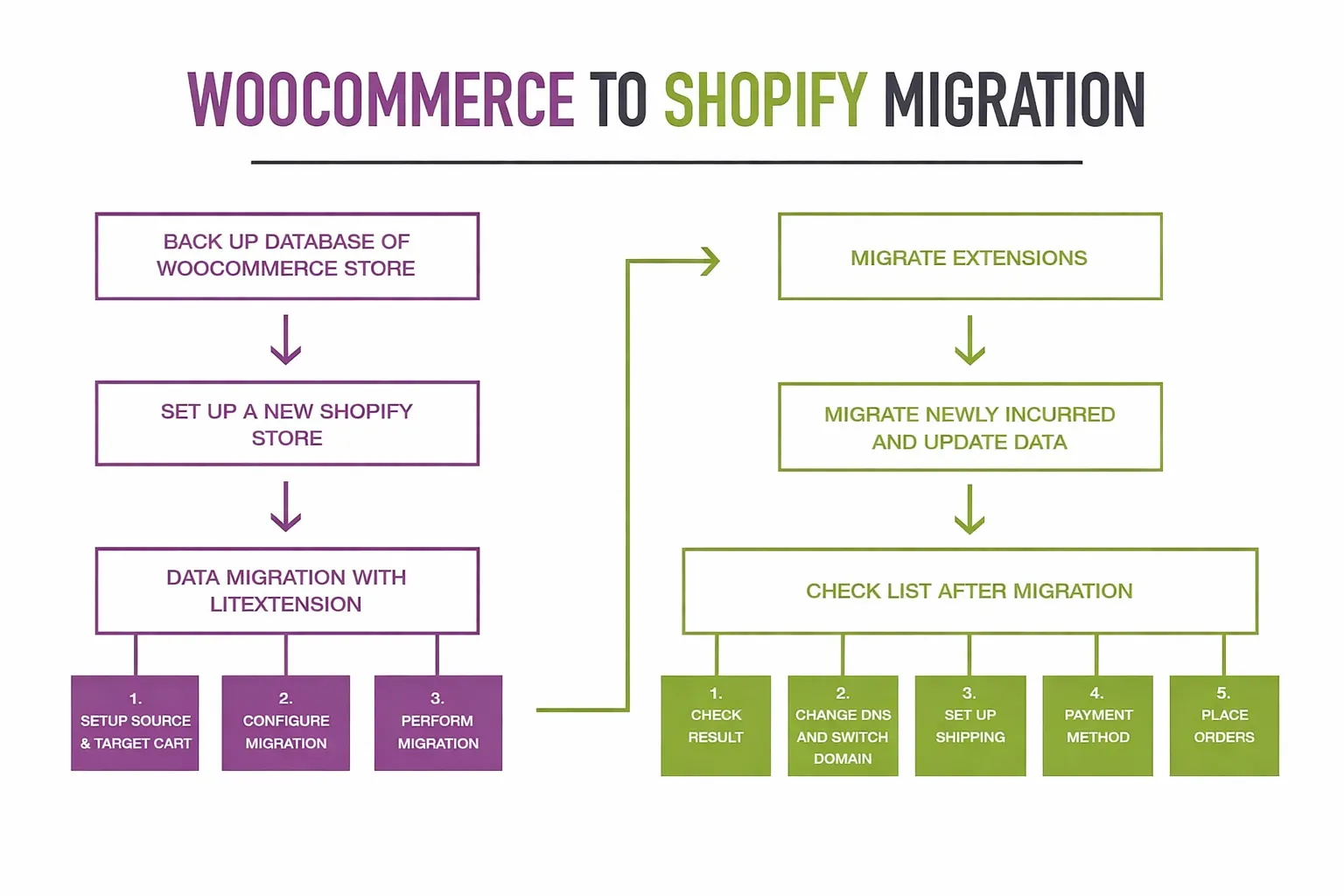
Understanding the WooCommerce to Shopify Migration Process
Migrating from WooCommerce to Shopify is a multi-stage process designed to protect both your business data and customer experience.
The first stage is strategic planning. This involves reviewing your existing WooCommerce store, identifying critical data, and understanding which features must be recreated on Shopify. Plugins, custom checkout logic, pricing rules, and integrations should all be audited at this point.
Next comes data mapping, where WooCommerce fields such as products, categories, orders, and customers are aligned with Shopify’s data structure. Since both platforms handle data differently, accurate mapping is essential to avoid inconsistencies or data loss.
The final stage is testing and deployment. Before launching, the Shopify store should be tested in a staging environment to verify checkout flow, payment gateways, shipping rules, emails, and overall usability. A structured migration process minimizes downtime and ensures business continuity.
What Store Data Needs to Be Moved to Shopify?
A successful migration starts with knowing exactly what data must be transferred and how it affects daily operations.
Products, Categories, and Media Files
Products form the foundation of your store. Migration includes product titles, descriptions, pricing, SKUs, inventory levels, variants, and images. In WooCommerce, categories and tags define structure, while in Shopify these are converted into collections.
Proper organization ensures customers can easily find products after migration, while media files such as product images and galleries must retain quality and correct associations.

Customer Accounts and Login Details
Customer data is critical for retention and trust. Migration typically includes names, email addresses, billing and shipping information, and account history.
Due to security standards, passwords usually cannot be transferred directly. Instead, customers are invited to reset their passwords securely on Shopify, allowing them to regain access without compromising data protection.
Orders, Transactions, and Purchase History
Order history provides valuable insights for analytics, customer support, and accounting. A complete migration includes previous orders, transaction statuses, payment methods, refunds, and order notes.
Preserving this information ensures your support team can respond accurately to customer inquiries and maintain uninterrupted service.
Different Ways to Transfer Data from WooCommerce to Shopify
| Feature / Aspect | WooCommerce | Shopify | What It Means for Migration |
|---|---|---|---|
| Hosting & Maintenance | Self-hosted, manual updates | Fully hosted, managed | Shopify reduces technical overhead after migration |
| Platform Stability | Depends on hosting quality | High, cloud-based | Better uptime and performance on Shopify |
| Product Management | Plugin-dependent | Built-in, streamlined | Products need proper field mapping |
| Design & Themes | Theme + plugin heavy | Optimized theme ecosystem | Design can be recreated with cleaner structure |
| SEO Control | High but manual | High with built-in SEO tools | Redirects & metadata migration are critical |
| Payment Gateways | Plugin-based | Native integrations | Requires careful reconfiguration |
| Scalability | Hosting-dependent | Easily scalable | Shopify suits growing stores better |
| Security | Owner-managed | Platform-managed | Security improves post-migration |
The right migration method depends on store size, complexity, and available resources.
Manual Migration Using CSV Files
Manual migration involves exporting data from WooCommerce into CSV files and importing it into Shopify. This method works best for small stores with limited products and minimal customization.
While cost-effective, manual migration is time-consuming and prone to formatting errors, missing images, and inconsistent data relationships.
Using Automated Migration Tools
Automated migration tools streamline the transfer process by handling data mapping, images, and variants automatically. These tools significantly reduce migration time and human error.
Although efficient, automated tools still require verification and testing to ensure accuracy and proper configuration.
When a Custom Migration Is the Right Choice
Custom migration is ideal for large or complex stores with custom plugins, advanced pricing rules, or extensive order histories. This approach uses tailored scripts and workflows to ensure data integrity and precise feature replication.
Custom migration provides maximum control and scalability, especially for enterprise-level eCommerce operations.
Preserving Customer Experience After Migration
Customer experience should remain consistent—or improve—after moving to Shopify.
Matching Your Store Design and Navigation
Shopify themes allow extensive customization to match your existing brand identity. Layouts, menus, and navigation can be recreated to maintain familiarity for returning customers.
Optimizing mobile responsiveness and page load speed further enhances usability and conversion rates.

Setting Up Shipping Zones, Taxes, and Payment Gateways
Shipping rules, tax configurations, and payment gateways must be carefully rebuilt in Shopify. Differences between WooCommerce and Shopify settings mean these cannot simply be copied.
Accurate configuration ensures smooth checkout experiences and prevents cart abandonment caused by pricing or payment errors.
SEO Considerations When Switching from WooCommerce to Shopify
SEO is one of the most sensitive aspects of any migration. Without proper handling, rankings and organic traffic can decline.
Protecting URLs, Redirects, and Search Rankings
WooCommerce and Shopify use different URL structures. Implementing 301 redirects ensures search engines and users are sent to the correct Shopify pages without losing authority.
Priority should be given to high-traffic and high-conversion pages to maintain visibility and rankings.
Migrating Metadata, Images, and Structured Data
SEO extends beyond URLs. Meta titles, meta descriptions, image alt text, and structured data must also be transferred accurately.
Maintaining this information helps preserve click-through rates and search relevance while allowing Shopify’s SEO features to work effectively.
Common Migration Challenges and How to Avoid Them
Even well-planned migrations can face challenges if safeguards are not in place.
Data Loss, Downtime, and Compatibility Issues
Incomplete backups, poor data mapping, or plugin conflicts can result in missing products, broken pages, or downtime. Performing staged migrations and maintaining verified backups reduces these risks.
Testing the Store Before Going Live
Before launch, it is essential to place test orders, verify payment processing, review email notifications, and check performance across devices. Thorough testing ensures customers encounter no issues once the store is live.
Why a Professional Migration Service Makes a Difference
While DIY migration may seem appealing, professional services deliver long-term reliability.
Accuracy, Security, and Time Savings
Professionals ensure secure data handling, accurate transfers, and faster execution. This allows business owners to focus on growth rather than troubleshooting technical issues.
Post-Migration Support and Optimization
After migration, expert teams assist with performance optimization, SEO audits, and Shopify feature enhancements. This ensures the store is not only functional but positioned for sustained growth.
Ready to Launch Your Shopify Store the Right Way?
If you want your WooCommerce to Shopify migration to be smooth, secure, and SEO-safe, a structured approach is essential. With the right planning, accurate data transfer, and expert execution, Shopify becomes more than a new platform—it becomes a foundation for scalable growth.
The next step is simple: audit your current store, define a clear migration roadmap, and execute the transition with confidence. Done correctly, your Shopify store can launch stronger, faster, and better optimized than ever before.
Frequently Asked Questions (FAQs)
Q1: How long does WooCommerce to Shopify migration take?
Small stores migrate in a few days, while larger or complex stores may take 1–3 weeks depending on data size.
Q2: Will my SEO be affected after moving to Shopify?
SEO can be preserved with proper 301 redirects, metadata migration, and URL structure planning.
Q3: Can customer accounts be moved to Shopify?
Yes, customer data is migrated, but passwords require a secure reset due to platform security rules.
Q4: Can I migrate my store without downtime?
Yes, staged migration allows your WooCommerce store to stay live until final launch.
Q5: Are WooCommerce plugins transferred to Shopify?
No, plugins are replaced with Shopify apps or custom-built solutions based on requirements.
Q6: Is professional help necessary for migration?
For small stores it’s optional, but large or custom stores benefit from expert-led migration.